
Preparation Considerations
Cutting
Characteristics:
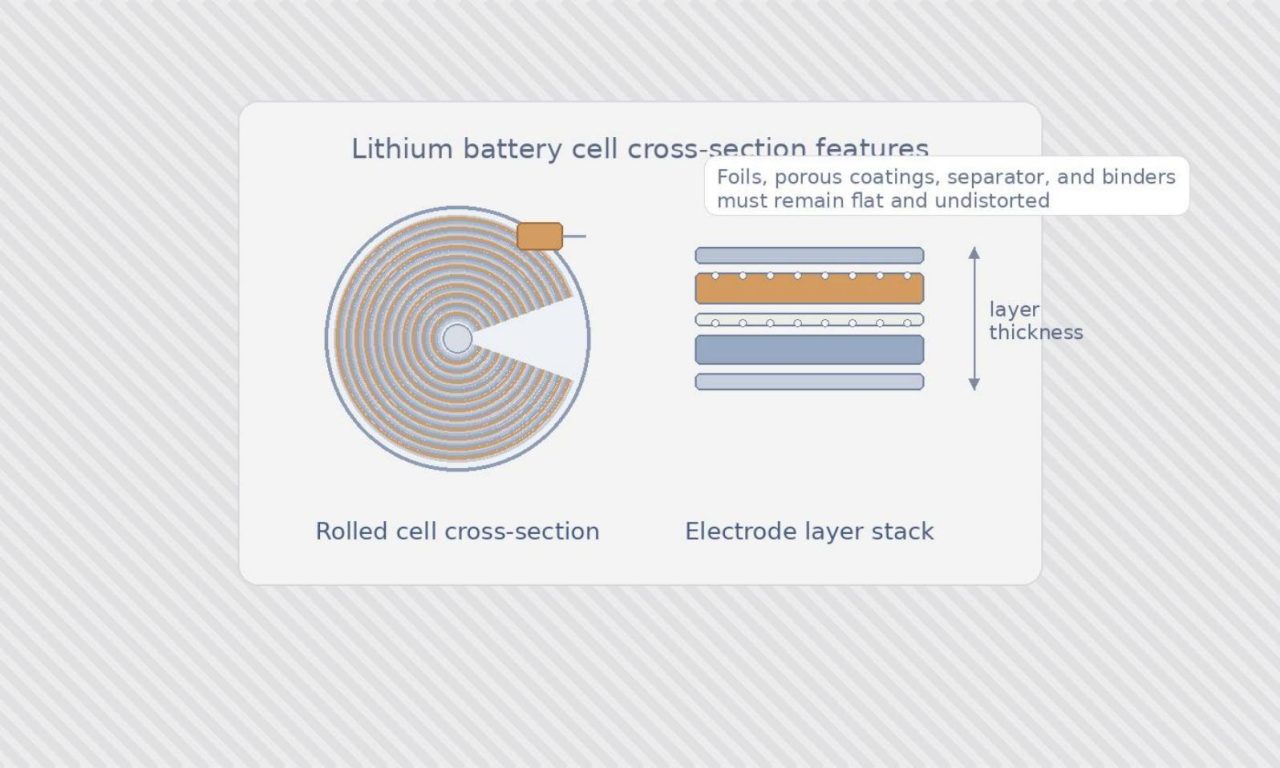
- Lithium battery specimens aremulti-layer systemsbuilt from metallic foils, porous active coatings, separators, binders, polymers, and welded connection areas.
- The rolled or stacked electrode structure ismechanically fragile;porous coatings, thin foils, and separators can tear, smear, buckle, or separate if the cut is too aggressive.
- Active cellmaterials can be highly sensitive towater, and some battery constituents are also sensitive to air exposure, so the cutting condition can alter the sample before grinding even starts.
- The region of interest is often alayerstack, tab, weld, cap assembly, or coating edge where geometry, thickness, and true defect morphology must be preserved.
More Attention:
- Battery cells shouldbe fully discharged and electrically safebefore sectioning so short-circuit risk is minimized.
- For active cell cross-sections, dry, low-damage sectioningispreferred so coolant does not react with or soak into water-sensitive laminate structures.
- Stable clamping, support, and cut orientation so thelaminate stackis not dragged, opened, or distorted during sectioning.
- Dust extraction and controlled cutting energy solocalheating, debris loading, and mechanical shock stay low.
- Whether the cut damageis shallow enough to beremoved later without losing thin foils, separator edges, coating boundaries, or weld details.
Avoid:
- Unsafe cutting of charged or partiallychargedcells.
- Coolant-related reaction, swelling, corrosion, or contamination of activeelectrodelayers.
- Smearing, tearing, or pull-out of porouscoatings andseparator material.
- Delamination of wound or stackedlayers caused byvibration, overheating, or poor support.
- Excessive kerf loss or cutting damage thatremoves the true featureof interest.
Mounting
Characteristics:
- Battery cross-sections often contain thin unsupported edges,internalporosity, powdery or porous coatings, and narrow gaps that need stable support before grinding and polishing.
- Accurate interpretationdepends on good edge retentionbecause many evaluations focus on foil thickness, coating thickness, separator condition, porosity, cracking, and interfacial separation.
- Heat andpressure can distort separators, polymers,binders, and soft internal features, so battery samples are generally more sensitive to mounting conditions than dense bulk metals.
- Air- or moisture-sensitive lithiated constituents can changeduringhandling, so the mounting workflow itself can affect what is later observed.
More Attention:
- Castable epoxy mounting rather than hotcompressionmounting when the goal is to protect fragile layered structures and minimize thermal or pressure distortion.
- Low-exotherm, low-reactivity resin systems so curingdoesnot overheat or chemically disturb battery constituents.
- Low-viscosity infiltration and, where appropriate, vacuumimpregnation so weak edges andporous regions are properly supported.
- Orientation of the stack, tab, weld, or cap regionbefore curingso the true plane of interest is fully supported and exposed.
- Minimizing ambient exposure for sensitive materials and preventingshrinkagegaps or specimen movement inside the mount.
Avoid:
- Hot-mount distortion of separators, binders,polymers, or other heat-sensitivelayers.
- Resin shrinkage gaps later misread asinterfacial separationor cracking.
- Incomplete support that allows foils, coatings, or separator edges tobreak outduring grinding.
- Mounting artifacts that are later mistaken for pores,voids,cracks, or delamination.
- Uncontrolled exposure that alters the appearanceor chemistry of sensitivebattery materials.
Grinding
Characteristics:
- Grinding must flatten a cross-sectionmade of constituents with very differentabrasion behavior, including aluminum or copper current collectors, porous active coatings, separators, polymers, and binders.
- Because battery layers are thin and often weaklysupported,the main challenge is removing sectioning damage without collapsing pore structure or creating heavy differential relief.
- Coarse or overloaded grinding candrag soft phases, fracturebrittle particles, or open weak interfaces that were not originally defective.
- For active-cell cross-sections, drypreparation is commonlypreferred so water does not interact with sensitive battery materials.
More Attention:
- Using SiCpapers and startingwith a relatively fine abrasive that still removes sectioning damage efficiently; for many active-cell cross-sections, preparation begins around P600 rather than with very coarse paper.
- Low platen speed,moderate load, and controlled stepprogression so flatness is maintained without adding deep subsurface damage.
- Frequent abrasive refresh and careful observation of whether theprevious stage’sdamage has been fully removed before moving finer.
- Edge support and whole-sample planarity so coatings, foils, andseparatorlayers remain in the same plane.
- Dust control, extraction, and operator protection duringdrygrinding.
Avoid:
- Starting too coarsely and driving grinding damage deeperinto theelectrode stack.
- Severe differentialrelief between foils, porous coatings, separator films, andresin-supported edges.
- Smearing of metallic foils or binder-rich material acrosspores,cracks, or interfaces.
- Particle pull-out, coating breakout, or separator collapsecausedby excessive load.
- Carrying amechanicallydamaged surface forward into final polishing.
Polishing
Characteristics:
- Final polishingmust reveal true layer thickness,pore structure, particle cracking, interfacial condition, separator integrity, and weld or cap details without changing their apparent geometry.
- A bright surface aloneis not enough:SEM, EDS, and dimensional interpretation depend on a flat, representative cross-section with minimal relief and minimal contamination.
- Battery electrodes can be sensitive to ambient airandmoisture, and contamination after final preparation can change contrast or obscure the real boundary condition.
- Fragile porous coatings are especially vulnerable to smear,rounding,particle pull-out, or pore closure if the polishing cloth, abrasive, and force are not well matched.
More Attention:
- A polishing sequence chosen to limitrelief and smearingacross mixed metal-polymer-porous systems rather than optimized for one dense material only.
- Low polishing force, adequate lubricant control, andshort, well-controlledsteps so soft or porous phases are not dragged across the surface.
- Checking whether pores, particle boundaries, coating edges,separators,and interfaces remain real and sharp after the final step.
- Minimizing post-preparation air exposure for sensitive lithiatedmaterials whenhigh-fidelity SEM characterization is required.
- For the most artifact-sensitive cross-sections, considering ion-beam finishingorcross-polishing when mechanical polishing alone may distort fragile porous electrodes.
Avoid:
- Resin, metal, or binder smear that hidesthe truepore network or crack morphology.
- Excessive relief that distorts real layer thickness orinterfacetopography.
- Air- or moisture-related contamination that changes surface appearanceafterpreparation.
- Pull-out, rounding, or collapse of fragile active particlesandporous coatings during the last step.
- A polished surface thatlooks clean butno longer represents the true battery microstructure.

3 comments
Geovanni Considine
January 25, 2018 at 9:35 am
Doloribus veniam qui quisquam. Voluptatem porro in magni. Voluptatem et doloribus voluptatum cupiditate itaque molestiae dicta quae.
Ms. Rita Thompson
January 25, 2018 at 9:35 am
Quaerat et deserunt tempore laboriosam iure suscipit libero quia. Impedit doloribus sed error quae debitis voluptas. Natus dolor sapiente beatae et et explicabo. Et totam et ea ut commodi voluptatem nulla quas.
Grant Hagenes
January 25, 2018 at 9:35 am
In aliquam rerum sunt eligendi cum et dolorem. Expedita repellendus aut totam inventore dolores.
Ut aut sint fugiat cupiditate dolor. Explicabo dignissimos et modi et facilis harum. Iusto consequatur nihil aspernatur ipsum atque.